











Select a category

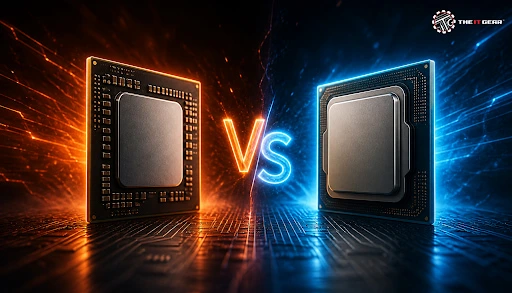
The AMD vs Intel debate is surely one of the hardest decisions for PC buyers in India today. Whether you're setting up a computer for gaming on the desktop, shopping for a work laptop, or upgrading an old PC, selecting between AMD Ryzen and Intel Core can be a bit of a challenge. When you're ready to explore your options, browsing a wide selection of processors can help you compare what's available in the Indian market.
The fact is that neither brand has a clear winning hand throughout its entire product range. That's why, the choice ultimately hinges on your planned use of the PC and your budget.
To most of us in an AMD processor vs Intel discussion, this question of 'Which is a better processor between AMD and Intel?' is the first and foremost question. We don't want any better brand. The thing is, it's the better match which counts for your purpose and your budget.
For Intel, the single-core performance generally is a plus as such, it can mean your apps are launching quickly, you can enjoy a game and be ahead with a high FPS. On the contrary, AMD Ryzen gives you a lot of multi-core power, which makes it popular for people doing video editing or even for multiple tasks. Also, nowadays AMD's 3D V-Cached, very innovative and unique in the field of technology, X3D chips are taking top place in all gaming benchmark categories.
Meanwhile, at the same time, Intel has been delivering an extremely well-balanced set for performance for content creation with Intel Core Ultra processors. So, if you keep on asking "which is better, AMD or Intel?", all that we can do is say that you should decide based on your workload and don't just stick to the old habits.
The topic of gaming is often the most controversial one in the debate between an AMD and Intel processor. Both brands of processors guarantee smooth gameplay but which is better really comes down to the type of game and the budget allocated.
AMD X3D Chips Lead the Gaming Race
AMD's latest release, the Ryzen 7 9800X3D (with 3D V-Cache, which is a kind of innovation in the industry) is rapidly gaining popularity for gamers wanting extreme fps in their favorite AAA titles. The reddit thread, r/BuildAPC submitters are moving over to AMD due to the lack of an equivalent X3D Intel product range.
If your primary concern is pure gaming performance, then an AMD X3D processor will provide the best gaming performance in the market with a very good price-performance balance. For those building a dedicated gaming rig, you might also want to check out pre-built gaming PCs for a hassle-free experience.
Intel Holds Its Ground for High-FPS Esports
Most of the esports players prefer Intel because single-core performance is so important in many FPS (First Person Shooter) games where every bit of advantage you get is going to count. The Intel Core i5 is a great option for budget-conscious esports setups as it offers high performance without exceeding your budget.
For light use like browsing or office apps, the performance difference between a Ryzen and a Core processor is hardly noticeable. That's why, selecting a laptop or desktop based on its thermal management, Wi-Fi support, and other features will be more important.
For video editing and other work that needs powerful computation, plainly a processor supporting many cores will be needed since that is AMD's biggest asset. That is the main reason many editors prefer Ryzen chips as they are faster and much cheaper. If you're building a system for creative work, you may want to explore content creation PCs that pair well with high-core-count processors.
For regular day-to-day photo editing with no need to run heavy programs or do lots of multitasking, either AMD or Intel will do very well. If you are using office software only, like Excel and PowerPoint, any recent processor will do just fine. Office laptops should be selected for maximum battery life and durable construction. AMD tends to give better value here, and Intel ensures your apps will launch quickly.
For Indian buyers, the budget often decides the winner. AMD processors typically offer more cores per rupee, giving value-conscious shoppers a clear advantage. Intel chips, meanwhile, may cost slightly more for the same performance tier because of their single-core reputation.
Power consumption is another factor: recent Intel processors draw more power than AMD's equivalent chips, which matters for energy bills and thermals. AMD also wins on upgrade flexibility, as its AM5 socket supports multiple processor generations, whereas Intel changes sockets more frequently, often requiring a new motherboard during upgrades. If you're planning a new build, understanding motherboard compatibility is essential before you commit to either platform.
Laptop decisions can make the AMD vs Intel processor choice question even more difficult. Intel powers many ultrabooks, providing Thunderbolt support, excellent single-core performance, and portability.
Professional software works well under Intel too. AMD Ryzen laptops, however, offer much better multi-core performance, a lot better battery life, and competitive pricing. If you just need a laptop for a regular office worker (you make a lot of calls, you have your spreadsheet and presentation programs, etc.), then Intel vs AMD processor choice isn't going to make a big difference and a Ryzen brand will usually have a bit more value for money. If you are after something really compact and very lightweight laptop, then you should definitely look at Intel-based models.
Let this guide be of your help to figure out the AMD vs Intel debate:
1. Maximum gaming FPS: AMD Ryzen X3D processor is the right selection offering flagship gaming capabilities.
2. Competitive esports on a budget: Intel Core i5 processor delivers top-notch high-FPS performance quite cheaply at the price.
3. Video editing and heavy multitasking: AMD Ryzen 7 or Ryzen 9 is the choice as they both exhibit a very clear multi-core performance lead.
4. For general office tasks, choose either brand given your budget and preference toward platform.
5. For laptops, Intel has the lead when portability, Thunderbolt, and ultrabooks are at issue.
If you are looking for multi-core speed, affordability, and a processor that can be upgraded without a change of PC then AMD Ryzen processor would be the better fit. A computer, where single-core performance and portability are important features then without question, Intel is still the right choice. If you want to build, upgrade, or repair your PC, come to The IT Gear to see different AMD and Intel processors and make the purchase without any worry. Be sure to also check out our custom PC builder guide to help you plan your next build.

Q1: Which is the no. 1 processor for PC?
There is no such thing as the number one processor; it varies with the usage. The AMD Ryzen 7 9800X3D is one that comes to the top for gaming, whereas Intel Core Ultra 9 285K is a content creation go-to.
Q2: What are the top AMD vs Intel processor recommendations from Reddit users?
The r/buildapc community mainly recommends AMD for the new generation gaming setups due to X3D performance domination. Yet, Intel fans still point out its edge for single-core esports, and responsiveness of everyday computer use.
Q3: AMD vs Intel processor, which one is best for a laptop?
Ultrabook users need Intel for Thunderbolt and portability, whereas AMD laptop processors offer good value on multi-core and longer battery life for work-related laptops.
Q4: Intel or AMD, which processor is better for everyday use?
They do quite fine in general use. Your platform choice, price, and energy efficiency will be the deciding factors in the end when you decide between these two. It's better that you think in these terms. For a deeper dive into processor specifications, check out our guide on understanding CPU specifications.





#No. 9, 5th Floor, Max City Center, T. P Lane, Sadar Patrappa Road, Bengaluru - 560002 (Karnataka)