










Select a category

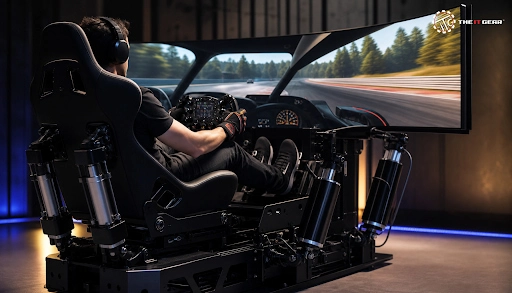
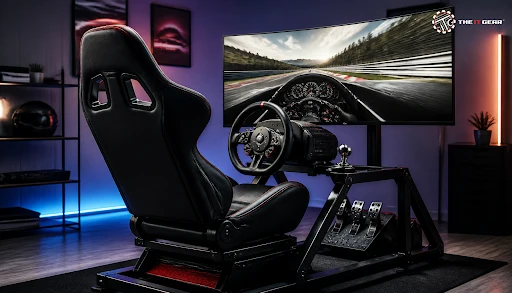
The sim racing domain has advanced a lot and now you have just a controller and a fixed desk that you can race with. An Indian sim racer who wants to have a realistic driving experience through gaming, will require a piece of equipment known as a motion simulator which would be the most advanced one.
A static simulator has one fixed frame, whereas a motion simulator adds physical movement, so when the car accelerates, pitches or rolls, all these are kind of replicated. This innovation is no longer something that only racing professionals have, but sim race fans at home are able to access the technology too. Yet it's a considerable leap in cost, so the big question is still: would a Fanatec motion simulator or even any other company's system be a good enough purchase for your home workshop?
A motion simulator is a piece of hardware which physically moves your simulator to recreate the experience of the driving conditions. Whereas a simulator where the frame stays completely still, it is referred to as a static one, motion simulators use actuators that move the frame in different directions such as the front-back axis, the left-right axis and the up-down axis, thereby creating realistic car movements.
With the use of the platform's tilt and movement during the driving simulation and through that, the motion simulator will allow the sim racers to experience the forces that are applied on the vehicle's tires during cornering braking acceleration, etc.). Ultimately, one's whole body will be made aware of the different car movements by the motion simulator through the use of the body's vestibular system which offers an integrated awareness of the head's position in space and of any movement of the trunk or head.
In the absence of such a system, the driver cannot be in full control of their driving, as a static simulation simply disregards one's physical sensations.
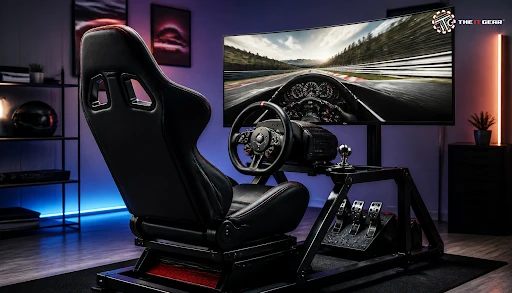
The physical feedback is the main reason a motion simulator differs so drastically from a static one. The driver in the static simulator gets only a visual representation (the screen) and a haptic feedback (the wheel and the pedals) of what is happening to the car.
On the motion sim racing rig, the simulation of the driving conditions will be reflected as physical movement of the driver's seat/foot rest/harness which means that the driver will feel the motion. As an illustration, the driver experiences pedal resistance when hard braking in the static rig. However, in a motion rig, the platform tilts forward, the driver gets pushed against his harness, and because of this the simulation of real-life sensation is complete.
Understanding these differences is something important in developing an ability in sensing, interpreting, and responding to vehicle dynamics and behaviors during racing at different track setups.
Buying a motion car simulator you may come across terms like 3DoF and 6DoF. They are the abbreviations from Degrees of Freedom that refer to how many movements the platform can do independently.
A 3DoF device can only follow rotational motion (pitch, roll and yaw) that it is possible to tilt the platform forward/backward, left/right and rotate the platform. A 6DoF system includes translational motion (heave, surge and sway) too, whereby the platform can move up/down, forward/backward and side-to-side respectively.
The best 3DoF systems for sim racing offer a good and comfortable level of immersion without needing a lot of motion technology. On the contrary, the use of 6DoF systems for sim racing is mainly to support and train pro drivers or for the very expensive, highly-detailed flying simulations.
The main hesitation when someone is trying to upgrade to a sim is the return on their investment. There is not just a simple truth about that question - it is really complicated. If there isn't any quality system underneath it, a basic 5cm motion system is going to create more bad than good through conflicting cues and improper reactions.
But if you get a good system integrated properly then you can get the same muscle memory and driving technique that real racers do. Besides speed, it's worth thinking about to help the whole experience. Most Indians who have invested in a motion simulator say the real benefit is the amount of fun and realism it brings.
The Danger of Bad Motion Cues
One of the most important things said by car driving coaches is "a motion simulator that will train you the wrong instincts, is just worse than no motion." For example, a motion system that has either a very high latency (delay between your pedal push/input and the motion) or unnatural yaw characteristics (rotation) will be training you in reacting in a wrong way.
That negative training may become a real challenge for you after the track. So, the "worth" your money is for motion simulators is closely connected to the product's quality. Cheap setups that skip the proper tuning and software calibration can even hinder your technical development.
The Benefits of High-Quality Motion
If you use an excellent motion setup, you have gained a lot. It is through this system you are able to experience the various stages that a suspension goes through, the changes in dynamic weight, the breaking of the tyres' traction and other complicated car dynamics that would be extremely difficult to sense or understand on a static rig.
You get this information physically, which is why you will probably become more of an intuitional driver as your body learns to predict the reaction of the vehicle. A motion platform is a great aid in a driver's progression to improve lap time and vehicle control so it also helps them stay competitive in races. For this reason, a great motion car simulator is very educational as well as competitive.
If the cost of a motion setup is too high for you then look out for the alternative in haptics. Through haptics you get physical feedback by vibrations. You can install a vibration generator on your chair for it to respond to engine movements or even connect it to a set of foot pedals which will let you feel a loss of contact between the tire and the road surfaces.
Although the addition of tactile feedback is a very good value and haptics have a price tag a couple of times cheaper than motion, they really are not able to physically recreate the effects of changes in weight distribution and other factors. Haptics are your touch, a very different, but equally valuable sense, and motion is the sense of body movements.
So many would say starting your journey by setting up an advanced haptic system is the best way to be physically in the car without any extra financial burden and then, after some time, go for a car with the complete motion system.
The starting point is usually not the full-fledged 6DoF platform but a more modest motion system for most home users. The "best budget motion sim" mostly falls into two kinds: seat mover and platform actuator models. Seat movers are typically more pocket-friendly and easy to put up, and they recreate the feel of a turning direction.
Platform level actuators (e.g. the 2DoF or a 3DoF kit) come at a higher cost but give you a much richer and more realistic sim racing immersion. Your current rig needs to be stable when it comes to the rigidity of the structure of a motion platform system to work properly. And, don't forget to think about the way your monitors are placed. The immersion increases in rig-mounted screens but those can sometimes wobble whereas static ones give you no issues.

Before finalizing your order, here is a handy checklist to guide you through the different elements to be considered.
1. Define Your Budget: Motion platforms start with very simple seat movements and end at high-level six-axis platforms. Do not go beyond your set limit.
2. Assess Your Rig: Make sure your cockpit is sturdy enough to be compatible with the force of a motion simulator. Consider options like the Next Level Racing F-GT Elite or the Playseat Trophy.
3. Check Compatibility: The motion system should, as a minimum, work with a wheelbase, pedals, and sim software like Assetto Corsa. Look into compatible options like the Moza Racing R9 V3 Direct Drive Wheel Base or Fanatec CSL DD QR2 Wheel Base.
4. Prioritize Quality: An ill-conceived cheap motion unit will be worse than an excellent static setup. See what customers say, and read reviews.
5. Plan Your Space: Motion rigs take up a lot of space and require a solid floor. You also need to factor in the disturbance caused by the system as well as the energy it will consume.
To sum up, the choice of whether or not to get a motion sim largely hinges on one thing: if a motion sim is going to be the most helpful thing to reach your goals on your sim racing journey. A static rig is a great tool when it comes to practice and it's practical to set up.
However the immersion with a motion sim is a whole different level of realism which will help you better grasp the nuances of driving. Indian sim racers who are looking to upgrade their rigs from static to motion would definitely benefit from this change even though it is quite a step. Whether you are buying a new wheelbase or the whole cockpit from Fanatec, we at The IT Gear are more than pleased to assist you with constructing a perfect racing environment.
Q: Will a motion simulator make me faster?
A: A motion simulator may help your driving improve but the extent of the effect depends on various factors. With a well-built and tuned motion feedback set-up you will gradually develop a car control technique which is based on muscle memory and good instincts and this way may eventually lead to faster times. The issue is that an incorrectly or poorly setup and tuned motion simulator may not only fail to benefit you but may instead result in your becoming slower since it is likely that the simulator will teach you wrong ways of reacting that you then carry over into actual competitions.
Q: What is the difference between 3DoF and 6DoF motion?
A: 3DoF (Degrees of Freedom) permits for movements of rotation (pitch, roll, yaw), which is to say, the entire rig will be moved by tilting and/or rotating around its axes. 6DoF enables translating movement (heave, surge, sway) which is allowing the platform to move up/down and forward/backward beyond the standard features. The result is more accurate simulation of real driving conditions.
Q: What is the most accurate simulator?
A: Full-motion 6DoF simulators at professional level have the most exact and highest fidelity simulation. Still, from a home user's point of view, a 3DoF system with fine tunes and better components might be a great choice for a simulation with a really high level of realism.
Q: Can I use a motion simulator for flight simulation?
A: Definitely, you can. Many motion platforms nowadays are made to function as well with racing as they are with the flight simulation games. Due to this, it is a valuable piece of equipment, and you can be sure to have a whole lot of fun playing various simulation games with it.
Q: What is the best entry-level motion system?
A: You can say that the best entry-level system is probably a 2DoF chair mover or a cheap actuator kit. Those are definitely less complicated to put together and also you won't have to part with too much money for these, so they are the perfect choice for sim racers trying sim racing for the first time.





#No. 9, 5th Floor, Max City Center, T. P Lane, Sadar Patrappa Road, Bengaluru - 560002 (Karnataka)