







Select a category

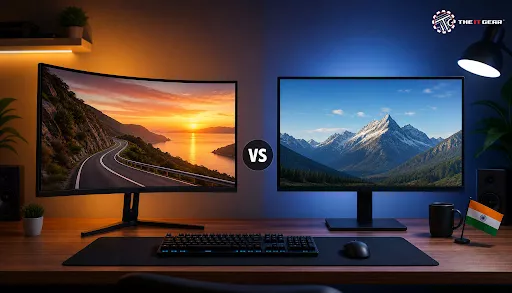
Choosing between a curved PC monitor and a flat one is one of the common dilemmas that Indian PC builders, gamers, and professionals face. The Indian monitor market is expected to witness huge growth. Display is one of the most essential things when building a PC.
Curved monitors are known for the immersive, wrap-around experience that they offer. Still, flat monitors have been getting praises for accuracy and versatility. This article aims at highlighting the main differences and pros & cons so that you can figure out which type of monitor really suits your needs and budget.

The main difference is in the physical design and how it affects your experience of use. A flat monitor is a plain two-dimensional screen whereas a curved monitor's screen curves inwards wrapping around the field of view.
The main purpose of a curved monitor is to offer an immersive experience by putting screen edges closer to eyes, this reduces distortion and makes the image more natural. This feature is mainly noticeable on bigger screens (27 inches and above).
The curvature helps in keeping the distance between the screen and eyes almost constant, which is less tiring for eyes. Meanwhile, a flat monitor works as a straightforward and distortion-free viewpoint. It is the best option for any work involving perfectly straight lines and accurate color rendering.
It is the most frequently asked question among gamers. The right answer is totally up to the kind of games that you play and what kind of performance you want to accomplish.
Curved Monitors for Immersive Gaming
If you have single-player, story-driven games in mind such as Cyberpunk 2077, Red Dead Redemption 2, or Assassin's Creed, then a curved monitor is the way to go. The curve adds a deeper level of immersion by enhancing your depth perception and peripheral vision, making it seem like you're really inside the game.
On one hand, it makes cinematic sequences and huge outdoor environments more enjoyable. And to add to that, ultrawide (21:9) curved monitors give a panoramic view that is unmatched by flat monitors. In fact, immersion is the biggest plus, as a result turning gaming into a mini-theater experience.
Flat Monitors for Competitive Gaming
If you like playing online fast games such as Valorant, CS:GO, Call of Duty, or Fortnite, a flat monitor would be your best companion. Almost all pro players of different games rely only on flat monitors. Why? Because for screens smaller than 30 inches the curvature hardly brings any significant help and the edges may even get a bit distorted sometimes.
Besides, with a flat monitor, you get the same color and brightness all around the screen which is absolutely necessary for quick spotting of enemies. On top of that, they are frequently the ones with the fastest response times and the highest refresh rates (144Hz, 240Hz, 360Hz) that also come at lower prices. The necessity of having pixel-perfect precision and consistent visual information makes a flat panel the best option for professional competitive play.
The answer is a bit complicated but generally speaking, yes they can. The curve is made to resemble the shape of the human eye so that every part of the screen is almost at the same distance from the eyes. This way, the eyes do not have to keep adjusting when moving between the center and the edges of the screen.
The consistent viewing distance can greatly lower the chances of eye strain, tired eyes, and dry eyes which are some of the common problems for people who spend 8-10 hours a day staring at a screen. Still, these effects are highly dependent on the screen size and are best seen on bigger monitors (27 inches and up). On smaller ones, the difference is hardly noticeable.
Choosing the most suitable monitor for work largely depends on the nature of your job.
For General Office Work and Coding
If your work consists mainly of coding, typing, or simply handling spreadsheets a curved monitor would be a good choice. It creates an effect that helps you to include the farthest edges of the screen into your peripheral vision so that you do not have to move your head all the time. That is why many users on Reddit declare that a curved ultrawide monitor works wonders for coding as it enables them to see much more code than usual and that's why not having to scroll all the time.
The other very important point for long work hours is that there is reduced eye strain due to the fact that there is no need for the eyes to be changing focus all the time.
For Design and Precision Work
Those who work in the fields of graphic designing, video editing, and CAD should generally stick to a flat monitor. First of all, for professional work one needs to be able to accurately draw straight lines and be able to rely on color consistency across the whole display.
On a curved screen, you can get some distortion that makes even a straight line look slightly bent, which happens to be the very reason why a curved monitor is not the best choice for architectural blueprints or photo editing. Although nowadays curved monitors are quite good, a high-end flat IPS model with colors calibrated directly at the factory is still the ruler for color-critical work.
This question is what most competitive gamers would like to know. The main reason is that the advantages of the curved monitor, i.e. getting a more immersive feeling and having almost edge-to-edge color and brightness uniformity, are the two features that perform least well when the screen size is that small (usually 24-27 inches) which is what esports pros are most often using these days.
On a 24-inch display the curvature is very subtle and hardly brings any benefit. Besides, the top-notch refresh rates (360Hz and above) and lowest input lag necessary for high-level competitive gaming are usually available only on flat monitors. If you consider that a slight distortion can occur on curved screens, it's understandable why pro gamers won't compromise even a millisecond of their reaction time due to curve distortions.

If we consider a curved and flat monitor, the deciding factor should be your main use. If it is gaming and productivity with less eye fatigue, a curved monitor is the way to go. When the requirement is accuracy and competitive gaming and professional design work, a flat monitor is the better alternative.
One single "best" monitor that fits all does not exist. We suggest you visit The IT Gear to check out our numerous monitors and get your ideal display that fulfills your needs and expectations. The correct monitor will change your computing experience quite a bit, so do not take the decision lightly.
What is the better choice between using a curved monitor or flat one for general purposes?
For routine activities such as web surfing, video watching, and doing paperwork, a curved monitor helps create a more comfortable and immersive atmosphere, most of all if it is a large-sized one. A flat monitor still is a reliable, all-purpose, and often less expensive option that is great for everyone.
Are curved displays better than flat ones for mobile phones?
The situation of mobile phones is different. Curved displays on phones mainly serve to offer a more attractive and higher quality feel, as well, less bezels. But, they are more liable to getting your touch input by mistake and there are fewer options to ensure their protection with screen guards. Flat displays on phones are more suitable and robust.
Which is better for the eyes, a curved or flat monitor?
The main reason why a curved monitor is better for the eyes is that it keeps the distance from your eyes to the screen more or less the same all over the screen. The eyes do not need to refocus all the time which reduces eye strain, in particular with bigger monitors.
What kind of monitor do coders use mainly?
Curved ultrawide monitors are what people usually go for when coding. 34-inch monitors make you view a lot more lines of code and multiple windows without setting up multi-monitors. Another great thing, the lesser eye strain is a really nice factor for long sessions of coding.





#No. 9, 5th Floor, Max City Center, T. P Lane, Sadar Patrappa Road, Bengaluru - 560002 (Karnataka)