








Select a category

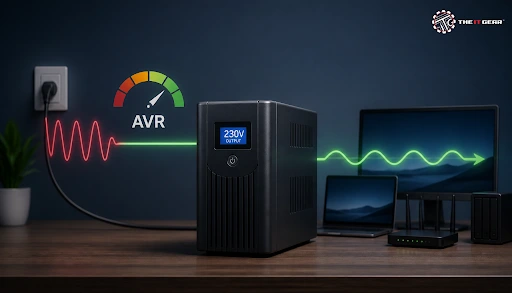
Voltage fluctuations are a reality in many Indian cities and towns, which is the reason for the use of AVR and UPS systems to protect sensitive electronics. We often face situations like sudden voltage surges or extended brownout periods, but most people don't realize the damage they cause to their computers, TVs, Wi-Fi routers, and other appliances.
An AVR UPS combines battery backup and automatic voltage regulation features into one unit, making it a necessary device for homes and workspaces. This article outlines all aspects of AVR UPS systems with some tips for selecting the right one, their advantages as well as how they function.
An AVR UPS is an uninterruptible power supply that also has Automatic Voltage Regulation capabilities (AVR). Compared with the regular type of UPS that only acts as a last resort when power is off, an AVR UPS actively detects and regulates incoming mains electricity at all times.
The working principle is centered on comparing the fluctuating incoming voltage with an internally set reference standard using a buck-boost transformer and delivering it to devices as stable and safe power. This correction occurs within a very short period, making sure that connected devices continue to operate with unvaried and clean power supply. The feature of AVR being activated only when main supply is normal means that there is constant protection against different voltage level irregularities through a regular time span, rather than just when a grid failure occurs. That's why an AVR UPS has to be seen with the major distinction from a simple and basic battery back-up unit.
Fluctuation and irregularities of the supply voltage pose more threats to electronic equipment than sudden and complete cuts in electricity. These threats can be neutralized by the use of an AVR UPS which brings protection mechanisms at different levels. It's highly recommended for areas with unstable power grids.
In fact, what sets an AVR apart from the usual power back-up device is that it does so much more than just storing power and giving it back. Here's a list of reasons why you should probably get the one with an integrated Automatic Voltage Regulator:
1. Sensitive Electronic Protection: Modern devices such as computers, gaming PCs and smart TVs have microprocessors which are very sensitive to voltage fluctuations. AVR gives a means of protection and filtering by stopping harmful voltage variations from reaching these critical parts.
2. Longer Equipment Life: A change in the voltage level - from a surge to a sag - results in stress on electronic parts, gradually leading to the breakdown of these components. AVR supplies even voltage, reduces thermally-induced stress, and helps machines run for a very long time within design specs.
3. Better Operation: If the voltage level fluctuates, then it becomes a problem for the electronic device as it leads to glitches, unexpected reboots, and acting in erratic ways. With an AVR, a consistent delivery of voltage level is ensured, meaning that a device running off it won't be affected or stopped, and it will continue to perform well with no interruption of the power supply.
4. More Efficient Battery Use: Minor voltage level changes can be managed by the AVR without the battery getting involved. This conserves the battery for the rare occasions when the electricity has failed completely, reduces the number of unneeded charge-discharge cycles taking place, and greatly increases the battery's functional lifetime.
5. Reduction in Operational Costs: Fewer failures in equipment result in lower repair and replacement charges. And, with longer battery power, less downtime, and prolonged equipment life, you will save a lot of money over time.
Although AVR and UPS are power protection solutions, their function is somewhat different. Knowing the difference helps you find the optimal solution for your power situation. This table compares the different functions or the differences between the features of AVR and UPS in detail, for a better overall understanding.
Given the circumstances in your environment, one solution will not necessarily be "better" than another. For instance, if your region regularly suffers from power voltage variations but the power grid is mostly present, a simple AVR might be all you need.
But if you have both frequent supply voltage instability and power outages, then you need the one with AVR that also gives batteries - that is, a UPS. Generally speaking, for most homes and businesses in India, a line interactive UPS with AVR brings the best possible protection since both power functions are merged in one cost-effective unit.
Yes. Having a separate AVR and a UPS system would form a protection unit in two levels. Firstly, the voltage fluctuations are regulated by AVR and this way, the power coming into UPS is of a clean input. Meanwhile, UPS is capable of powering the complete load for the duration of an outage, using its battery source. This kind of layered solution is typical for data centers and other highly critical operations when stability and continuity are two equally required things.
The answer is not always. The reason is that many UPS models do not have a built-in AVR. As a result, low-end models can only offer a power source during outages and protect against small surges. On the contrary, mid-range models and high-end models come standard with AVR. On top of providing AVR, some models of premium UPS are equipped with remote monitoring tools and network capabilities.
When you plan to buy a UPS, you must verify whether it comes with an AVR installed or not. In fact, you cannot risk not having a regulator if you live in an area where voltage fluctuations are the norm. A line interactive UPS with AVR is the most recommended purchase for the general user because the unit is stable and has the capability of delivering a stable and clean power without the premium price of online double-conversion models.
When you plan to get a line interactive UPS with AVR for your home, you must consider several points:
These kinds of products that have voltage regulation and UPS functionalities combined together are sometimes referred to as an automatic voltage stabilizer, which is suitable for a home setting.
It protects the household appliances from the electrical supply fluctuation and the devices like the fridge, television, computer, and Wi-Fi router etc. During the outage, it also gives the battery backup. Many established brands have devices starting from 600 VA to even 2000 VA, which can cater to various household requirements. For a deeper understanding of how to match your power requirements, you can also refer to our guide on UPS ratings explained.

An uninterruptible power supply with an Auto Voltage Regulator (AVR) is no longer seen as something extra but has become a vital investment in protecting important equipment from the unpredictable nature of electricity supply. With its voltage regulation function as well as emergency backup battery, an AVR UPS brings two functions in one device giving more protection.
The IT Gear carries many UPS systems with AVR built-in manufactured by renowned companies, making it easy for you to decide the right one for your home or office. Visit The IT Gear's website now to review the UPS models we have in stock and equip your system safely.
What is the AVR full form in electrical?
Voltage regulation is carried out by the Automatic Voltage Regulation mechanism and it's represented by AVR in electrical devices.
What is AVR full form in a microcontroller?
In microcontrollers, AVR stands for Atmel's RISC-based microcontroller architecture used in popular chips like ATmega and ATtiny series and not Automatic Voltage Regulation.
What is AVR full form in cardiology?
In cardiology, AVR stands for Augmented Vector Right that is one of the leads used in ECG (electrocardiogram) machines to record the electric current of the heart.





#No. 9, 5th Floor, Max City Center, T. P Lane, Sadar Patrappa Road, Bengaluru - 560002 (Karnataka)