






Select a category

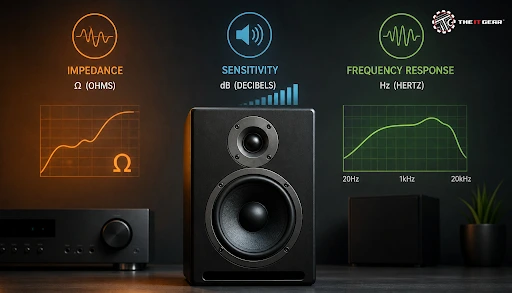
It's easy to get lost shopping for speakers online in India if spec sheets come out with technical terms like impedance, sensitivity, frequency response and power handling without a detailed definition. In reality, these speaker specifications precisely reveal to you in advance what a particular speaker can do before you even play a track of your favorite song on your device.
Be it that you're looking for a pair of speakers for your room or a Bluetooth speaker which you can carry anytime, knowing these numerical values will help you produce the best sound out of your money. This article simplifies all the crucial specs for you without the jargon.
A speaker specification is nothing but the set of technical figures that describe how a speaker is supposed to work. The list includes the electrical aspects like impedance (ohms) of the speaker, the speaker's sensitivity (the more the value, the less the noise) as a measure of efficiency, and it also covers the maximum sound frequencies (high frequencies and low frequencies) that can be heard. The last one is about power that a speaker can resist from the system without any damage or distortion, etc.
These specifications are basically a forecasting tool, as they tell you how much volume a speaker can produce at a certain sound level, how much power it consumes, and which frequencies it reproduces accurately.
Impedance (Ohms) - Matching the Speaker with Your Amplifier
If we consider an example, a speaker with a low impedance will draw more from the amplifier compared with a speaker having a higher impedance. If equipment can handle a lower impedance, such as say 4 ohms and less when it comes to a 4-Ohm speaker, it is going to need a more powerful amplifier. Otherwise, the amplifier will work hard and may overheat.
When you connect your speakers, you have got to be aware of the capability of the speaker system you bought to handle the speaker's nominal impedance, which is the one you see in the box or the specifications provided by the maker.
Sensitivity - The Efficiency Rating in dB
Sensitivity is a measure of how much sound a speaker emits per given power. Sensitivity rating is the power at which the speaker produces a certain sound level. In technical terms, sensitivity specifies how much electric signal a speaker needs to produce a given volume.
For example, in sensitivity testing, the microphone measures at 1 meter the sound of the speaker with the signal of 1 Watt. A speaker has a sensitivity of 85dB if the sound level measured is that of 85dB at 1 Watt and the distance is 1 meter.
A speaker that is rated at 90 dB sensitivity will play a lot louder than an 85 dB one if both are fed the same amount of power. A speaker of high sensitivity is ideal to be paired with a low-power amplifier, whether it be a tube/valve amplifier or not, making it an important specification for audiophiles. This is less of a concern for devices whose amplifier is integrated, like Bluetooth speakers, because amplifiers will have already been matched at the production stage.
Frequency Response - Measuring the Sound Range
Frequency range is the range of sounds a speaker can reproduce measured in Hz (cycles per second) where 20 - 40,000 are the human hearing ranges. A speaker's frequency response range is normally written as something like "50 Hz to 20,000 Hz +/-3 dB".
That would be the lowest and highest frequencies your speakers could reproduce without any distortion or drop in their reproduction capacity at a certain frequency. Flat frequency response refers to really the same amount of sound produced for every different type of sound, which means that such a speaker will not emphasize any particular frequency band and you will end up with a true-to-life sound.
Then again, if the curve is upward, your speaker is a high-fidelity one. The sound is going to be more crisp with more clarity in its upper range, mainly the highs, that are going to stand out. Check if your speaker has the low-frequency extension for deep bass. Is it equipped with high-frequency extension for bright treble? Also see whether midrange is flat enough to deliver clear vocals and instruments.
Power Handling - RMS vs Peak Watts
Power handling refers to the amount of amp power that a speaker can handle without being blown. RMS power is essentially the power that a speaker can handle for a long while. However, peak watts tell you how much power a speaker can take in short bursts. So, a 50W RMS speaker can handle safely a 50W RMS amplifier for moderately loud listening. But if you use a very underpowered amp to get the same volume, you might end up clipping the signal and so damaging your speakers. To have a clean and safe operation, choose your amplifier power to match your speakers' RMS rating.
You'll find it a lot easier to get the gist of sensitivity ratings if you see them in comparison with a standard chart:
Keep in mind, a change on a scale of just 3 dB really is a big change, as it means that the sound becomes twice as strong. So even small variations in these speaker specs produce a big difference in loudness experienced in life.
Even though some words used in Bluetooth speaker specifications are the same as those used for wired speaker specs, the focus of each feature will have a completely different meaning. The main difference is since Bluetooth speakers have built-in amplifiers, the concepts of impedance matching and external amplifier power become meaningless.
Rather than that, look at the output wattage for the loudness potential, the frequency range for the balance, and Max SPL, a speaker's highest SPL, which basically tells you what's the maximum sound pressure level your speaker will output without distortion. With portable Bluetooth speakers, aside from the standard features (watts, SPL, etc.), pay attention to the driver size and battery capacity as this will affect the performance. Don't forget to consider those and other specs before making any comparison on the specs of different Bluetooth speakers online.
Grasping the concept of speaker specs is not only an intellectual exercise but, more importantly, it empowers your speaker shopping decisions and takes the uncertainty out of spec sheets. Simply verify, for example, if a given speaker fits your listening environment, and that the speaker is compatible with your amplifier in both impedance and power level.
If you still find choosing the right speaker and audio accessories very difficult, then why not rely on our expertise at The IT Gear to guide you through it? We offer a great selection of speakers, headphones, and home theater components tailored to every need and price range of an Indian consumer. Visit us and compare real specifications side by side and make the right choice for yourself through experience.
Q: What methods do experts use to evaluate speaker specifications?
Typically, they go deeper than the manufacturer's official data, using various external sources like third-party reviews or independent tests to double-check the manufacturer's claims. Instead of solely trusting the official "rating," which is usually an average, experts are more interested in impedance curve, frequency response graph, and anechoic measurement (i.e., no reverberation) data. This way, they are better equipped to choose top-end products which suit them.
Q: For setting up a home movie system, what speaker specification should one pay the most attention to?
Sensitivity rating and power handling capability (Power Handling) are the two speaker specs which most directly relate to an AV receiver. They are what determine the volume that can be reached and the durability of the system under continuous operation. Also, a correct match in impedance level prevents amplifier overheating, so clean, artifact-free output at full volume is maintained during movie watching.
Q: Are bigger watts always the best factor for speaker sound performance?
In a way, no. Watts simply indicate how much power the driver can handle without burning out, not how good the sound is. In fact, a speaker that goes up to 200 watts will give a higher volume level and also be louder, but the quality aspects are actually not directly related to the wattage.
These factors include the quality of the individual components like drivers (e.g., cones, voice coils), how the speaker cabinet is made, the design of the crossover network (i.e., the electrical circuit that channels the different frequency bands), and the precision over which the speaker covers the whole spectrum of frequencies. In other words, sound quality is influenced much more by physical characteristics of the speaker than by how much power it takes.





#No. 9, 5th Floor, Max City Center, T. P Lane, Sadar Patrappa Road, Bengaluru - 560002 (Karnataka)