











Select a category

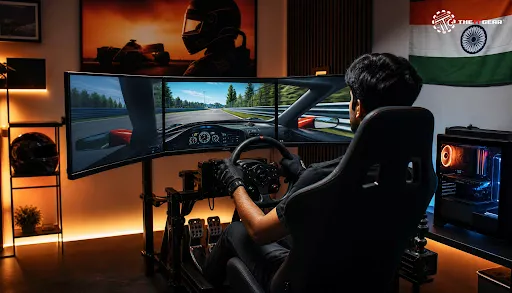
Racing simulators are becoming more popular by the day, and for Indian motorsport lovers, the dream of being a car driver without leaving their house has finally come true. As there are a lot many professional online racing leagues out there and lots of racing enthusiasts are coming forward with their gearheads, the cost factor of the sim racing setup is becoming the only major investment factor.
You need a sim racing setup if you are to go from F1 casual to becoming an intense player with Gran Turismo. The right setup can turn your game into a driving simulator that will help you get the hang of driving a car in real life.
A racing simulator setup is a set of hardware that replicates the feeling in the race car when you are driving it. You are probably not going to get the same kind of pleasure with your regular game console and controller that you would get from a racing simulator that you can really experience with.
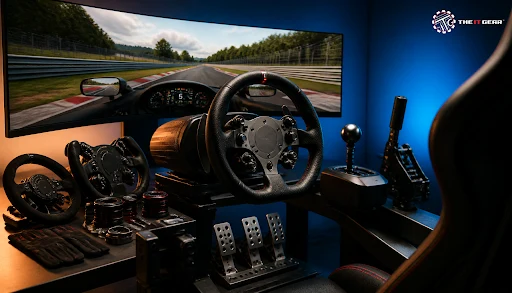
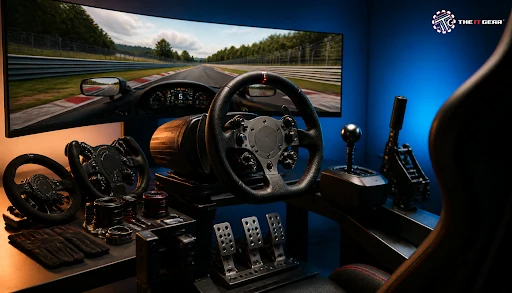
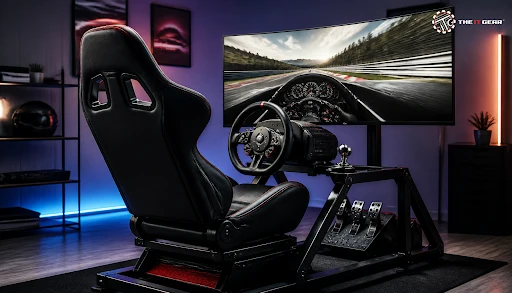
Basically, the sim racing setup consists of a wheel with a grip and a pedal. In reality, you would need a cockpit frame with a racing seat and a display system either monitors or a VR headset. Your main aim is to feel, via touch, the road, the brake lock-up, the oversteer, and other similar sensations as if you had an actual car. Because of this, the sim racing setup becomes an essential part of your car skills and pleasure in racing, making it a significant purchase for you as an Indian sim racers to become serious.
If you would like to assemble a race track with a sim racing cockpit, you will need to get a bunch of elements that work together to form the whole setup. It's a good idea to first understand each element of a racing simulator setup before moving on to your ideal build.
Racing Wheel and Base
This serves as the primary source of your input. In short, the base holds the motor that gives force feedback which replicates the sensations that you have driving a real car. Currently, the sim wheel market offers belt-driven and direct-driven systems, out of which direct-driven wheels are more realistic and stronger. You can explore options like the Thrustmaster T248R racing wheel or the Moza Racing R3 Bundle for a great start.
Pedals
A well-designed pedal set could do much more to your time consistency than even a great set of wheels. Advanced pedal sets make use of brake load cells which measure pressure rather than distance which simulates an actual hydraulic braking system better than a regular pedal. This, in turn, results in extremely accurate braking behavior. Check out professional options like the Fanatec ClubSport V3 pedals or the Moza Racing SR-P pedals.
Cockpit Frame and Seat
The cockpit frame is the sturdy base for attaching the rest of the equipment, preventing flex and ensuring that the steering wheel's force feedback is accurately translated to you without any disturbance. A racing sim chair gives you the right seating position from the ergonomics point, making long sessions more pleasant and also providing a connection to what the car is going through. Popular frames include the Playseat Trophy and the Next Level Racing F-GT Lite.
Display System
This may include one big screen, three monitors, or even a VR headset. Three monitors give a very wide field of view (FOV), which helps you in viewing corners while VR allows you to be virtually seated in the cockpit, a feature that is unrivalled with immersion. You can use a triple monitor stand like the Next Level Racing Elite Freestanding Triple Monitor Stand for the ultimate setup.
Building your own racing rig setup can turn into a profitable hobby that costs much less and is customised to your preferences only. The steps involved in this process are, of course, planning material procurement, and precise work of putting everything together. The Indian enthusiasts who have their hands on DIY are surely going to benefit from a great professional-level experience that won't have the professional-level cost in this way.
Planning and Design
Start your work with measuring your space, because a full cockpit can be a large installation. Your budget and the type of racing (e.g. Formula-style vs. GT-seating) you would like to do is going to be important in the decisions you make. You are able to download free plans on the Internet for wooden racing seat rigs that are widely used by DIY fans as a starting point.
Sourcing Materials
Purchasing cheaply is possible if you go for wooden materials. You need durable sheets of wood like plywood, the screws, and some of the basic tools like a drill and a saw. But, to get a more professional feel and at the same time modular build option, it will be good to get yourself a piece of steel 8020 material with a modular building system, a product from a specific hardware supply store, the only problem is they can be a bit more expensive.
Assembling the Frame
Cut your pieces as per your blueprint. As your structure's strength is essential, this component is going to be the last of the construction process. The foundation and the level of it must be of primary importance, so the next steps would be the creation of attachments for your wheel, and pedal base, and your chair. If the structure is not stable, the overall experience will be ruined and driving will be a challenge too.
Mounting the Components
Put on your steering wheel mount and pedals to the frame safely by bolts. Make sure of using the accompanying parts and that your frame doesn't have any give. Your race seat comes next. Adjust it so that your legs are just bent a little when you put your foot down to the pedals completely. Lastly, get your displays or VR headset running.
Once you are satisfied with the running of the main features of your sim rig setup, the rest of the hardware additions are to be considered to make the experience more life-like, almost as if you have the equipment in your car or on the racing tracks.
Haptic Feedback and Bass Shakers
Hanging up a bass shaker (for example a Buttkicker) near to the seat or pedals can dramatically change how you experience the car. It gives you different sensations through the seat or your feet (for example a road bump or a kerb hit or an engine sound coming from below), so you are able to "feel with" your senses as in the actual driving. You can consider the Next Level Racing HF8 Haptic Gaming Pad for an incredible tactile experience.
Ambient Lighting and Wind Simulation
Simhub will be able to control the lights (like, your light will go red if you are going to destroy the car and it will be yellow when the sun sets.) The wind simulation that could be made with using two to four PC fans to blow out air to the head will create the illusion of speed.
Perfecting Your Field of View (FOV)
Adjusting and optimizing your view angle is something that is both free and very important. Wrong field of view makes objects look faster/slower at screen corners while wrong FOV makes corners of images look faster or delayed than they are. You can calculate your proper screen settings by using an online FOV calculator for your screen sizes and distance from your eyes. Only this single change greatly elevates your distance judgments and driving consistency.
Although it is very subjective, one usually comes to the conclusion that it is just about the best and most expensive consumer gear that one can get hold of. These setups try not to let you distinguish simulation from reality.
Direct Drive Wheel and Load Cell Pedals
The core of realism is a powerful direct drive wheel base (those are available at Fanatec and Simucube, for instance) and top-grade professional pedals like Heusinkveld which together will deliver the highest quality of force feedback and brake pressure simulation to a consumer.
Motion Platform
A motion system (D-BOX or PT Actuator) takes the immersion further into new levels as it moves the cockpit to simulate the G-forces, hitting a bump, or an elevation change. Although it is an investment, for maximum realism, it is the last step to take. The Next Level Racing Motion Platform V3 is a fantastic example.
VR or Triple Screens
When it comes to display, a high-quality VR headset (e.g. Varjo Aeros) covers the most naturalistic 360-degree view. However, a triple-screen setup with very accurate alignment of screens and a bezel-free kit brings a breathtaking panoramic vision and also allows the users who are not suited for a VR device to use it more comfortably.

You should do a quick checklist before you complete your order or initiate your production to make sure that you have got everything you need to have for your racing simulator setup.
Setting up a racing simulator setup is a journey that pays off in countless hours of thrilling and realistic gameplay. From a simple DIY wooden rig to a professional motion platform, the key is to start with a solid foundation and upgrade over time.
The community in India is growing, and with the right gear from a trusted partner like [The IT Gear](https://theitgear.com/), you can be part of the action. Remember, the best setup is the one that fits your space, budget, and passion for racing. So, start planning, build your rig, and we'll see you on the track.
1. What is the best budget for a sim racing setup in India?
A good entry-level setup with a wheel, pedals, and a simple wheel stand can start from around ₹25,000 to ₹40,000. A full cockpit with a dedicated seat will typically range from ₹80,000 to ₹1,50,000.
2. How much is Max Verstappen's sim setup?
Max Verstappen's professional F1 simulator is a multi-million dollar system. It features a custom hydraulic motion platform, professional-grade components, and software integration used for team training, making it vastly different from consumer setups.
3. Is a sim racing cockpit worth it for beginners?
Yes, even a basic cockpit or wheel stand is a massive upgrade over playing on a desk. It provides a stable platform, correct ergonomics, and significantly improves your consistency and enjoyment.
4. Can I build a DIY sim racing cockpit with wood?
Absolutely. Building a DIY sim racing cockpit from wood is a very popular and cost-effective method. There are many free plans available online that guide you through the process, making it a great weekend project.
5. What is the difference between a wheel stand and a full cockpit?
A wheel stand only supports the steering wheel and pedals, requiring you to use your own chair. A full cockpit includes a dedicated seat and a rigid frame that holds all components, offering superior stability and immersion.





#No. 9, 5th Floor, Max City Center, T. P Lane, Sadar Patrappa Road, Bengaluru - 560002 (Karnataka)